
Preparing Houses of Worship for Protests Without Losing Peace, Witness, or Control
Introduction: A New Kind of Disruption
For generations; churches, temples, synagogues, mosques, and other houses of worship in the United States have expected protests to remain outside, on sidewalks, across the street, or at most, at the edge of a parking lot. Worship itself, once underway, was widely understood to be off limits.
Recent events suggest that assumption may no longer hold.
In January 2026, a coordinated protest entered a worship service in the Minneapolis–St. Paul area and intentionally disrupted the gathering from inside the sanctuary. Within days, two additional incidents; one at a synagogue in New York and another at a church in Southern California, demonstrated a similar willingness to treat places of worship as legitimate venues for political confrontation.
These events raise uncomfortable but necessary questions for faith leaders and safety teams:
- What happens when protest no longer stays outside?
- How should churches respond without escalating conflict?
- How do we protect children and congregants without overreacting?
- And how do we preserve worship, witness, and legality when provocation is the goal?
This article is not about taking sides in political debates. It is about recognizing a shifting threat pattern and responding with wisdom, restraint, and preparation.
The Minneapolis Incident: What Happened and Why It Matters
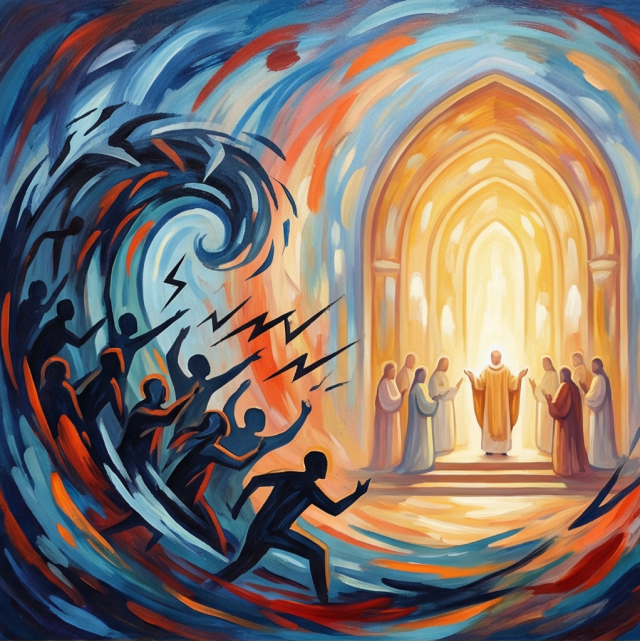
On Sunday morning, January 18, 2026, during a regularly scheduled worship service at a church in the Twin Cities area, a group of approximately 30–40 protesters entered the building together during the opening moments of prayer. The group consisted primarily of people related to Black Lives Matter Minnesota/Twin Cities and the Racial Justice Network. They moved quickly into the main aisle and front seating area. Chanting began almost immediately. The service could not continue.
The protest was tied to heightened immigration enforcement activity in the region and the death of a civilian during an ICE-related confrontation earlier that month. Activists later said they were using civil disobedience to object to the dual role of a federal immigration official who also held a pastoral position associated with the church, targeting both he and the church. Additional protests have occurred subsequent weekends, but due to a police presence, they have been kept outside. Interestingly; as a result of all this, numbers of parishioners at those subsequent services has significantly swelled according to those in the congregation.
From a safety and preparedness standpoint, several details are critical:
- The entry was coordinated, intentional and well planned.
- The timing was chosen to maximize disruption.
- The group entered as a unit, not as individuals.
- They took up strategic positions throughout the church.
- Ailes were blocked and movement was at the very least greatly hampered.
- Multiple cameras were present and recording immediately.
- Congregants report being shouted at, cursed, called evil and Nazis, and that they would burn in hell.
- The objective was not dialogue, but interruption, disruption and exposure.
The sanctuary was not treated as a sacred space
Congregants later described fear, confusion, and distress; particularly among families with children. While no physical violence occurred, the emotional impact was real. It has been reported that one person fleeing the incident fell, and broke her arm. Importantly, the disruption did not occur spontaneously. Planning took place in advance, including online coordination and day-of staging. The sanctuary was not treated as a sacred space, but as a stage. That distinction matters.
Two More Incidents, One Pattern
Within the following ten days, two additional incidents reinforced that the Minneapolis disruption was not an isolated anomaly.
Long Island, New York (January 28, 2026)
Activists entered a synagogue during a community event where a sitting congressman was speaking. The protest directly confronted the speaker over immigration policy and ICE funding, interrupting the event inside the building.
Southern California (January 21, 2026)
Protesters gathered outside a church hosting a large Christian event. While they did not enter the sanctuary, they positioned themselves at entrances and exits, directing hostile language toward worshippers as they arrived and departed.
Different faiths. Different regions. Different issues.
Same underlying tactic: apply pressure where moral authority, media visibility, and emotional vulnerability intersect.
Is This a Trend?
No one can predict the future with certainty. But churches should recognize several realities:
- Political polarization is not decreasing. Far from it. The intentions of many are to increase; dramatically.
- Activist tactics increasingly favor disruption over persuasion.
- Houses of worship are being reframed by some groups as acceptable confrontation spaces.
- Public figures, government employees, and elected officials often attend or speak at churches.
- Churches are highly visible, symbolically powerful, and often lightly secured. This makes them soft and easy targets to many.
In other words, churches may be targeted not because of what they preach, but because of who attends; or who is perceived to attend. A politician, or person of relevance to a protest group, may be known to attend your place of worship, even though they may not be there at the time. The protesters would likely see it as a home run if the person they’re targeting is there; but still acceptable as a solid ‘base-hit’ for the publicity impact they wish to have even if their target is not. If their chosen target only attends a few times a year, or hasn’t for years; in the protesters mind your holy house is still associated with them; so you’re a target too.
Your preparation is not paranoia. It is stewardship.
Understanding the Protester Playbook
Before discussing response, it helps to understand intent.
Most organized protest disruptions inside worship settings are designed to do any or all of the following:
- Stop the service
- Provoke a visible emotional response
- Capture that response on camera
- Frame and/or control the narrative, online or in the public eye
- Use any and all negative sound or video bites later for their purposes
- Raise awareness for their cause
- Enhance the standing of their group
- Gain as much publicity as possible
- Intimidate; influence; agitate;
- Stir up support
- To escalate their overall protest and presence
- Testing boundaries
Noise-making devices: Bullhorns, whistles, airhorns, sirens, are not incidental. They are tools to overwhelm calm leadership and force reaction. Blared inches from you, or even virtually touching, they are exceptionally invasive, intimidating, potentially harmful, and designed to illicit a response from your emotion. You may want to lash out. They want you to. You may want to cry. They want you to. It’s all done for their benefit, and they want to use you as their tool.
Debate is rarely the goal. Escalation and intimidation is. Understanding this helps churches avoid falling into predictable traps.
Understanding the Protester
What a church may face today ranges across a wide spectrum. At the mildest end is a lone individual standing quietly across the street with a sign; lawful, visible, and often seeking attention rather than confrontation. Slightly closer to the building might be a single dissenting voice who attempts to speak out before, during or after a service, or someone who enters briefly to make a point and leave. At times, this may include a person in emotional distress or struggling with mental illness who fixates on a grievance or religious objection and disrupts a moment unpredictably. These situations are often spontaneous, loosely formed, and driven by personal conviction rather than coordination. They may be awkward or uncomfortable, but they are typically limited in scope and duration.
…using you and your church as their tools…
Further along the spectrum are organized demonstrations. These can be planned hours, days or weeks in advance, framed around a hot-button political or social issue, and coordinated through social media. Participants may arrive in groups, record interactions, chant in unison, use noise-makers and attempt to move from public space into private property. Some groups train in messaging, positioning, and crowd dynamics; a few include experienced, even paid professional activists who understand media optics, legal thresholds, and how to provoke reaction without crossing certain lines. At the most disruptive end are loud, tightly coordinated actions designed to halt a service, create viral footage; meaning using you and your church as their tools, and to pressure leadership. Recognizing where an event falls on this continuum; spontaneous, emotional, organized, or strategically orchestrated; is essential to responding calmly, lawfully, and proportionately.
Response and reaction
The Core Principle: Calm authority and calculated response beats emotional reaction
Faith Guards emphasizes this foundational truth:
The church that remains calm, disciplined, and lawful under provocation retains control; even if the service must pause or end.
This is not weakness. It is strength. It is wisdom and control when faced with adversity. Adversity is temporary; our faith is forever. Weather the storm, but win the war.
Leadership and Authority: Decide Before the Crisis
One mistake churches might make is allowing or expecting the senior pastor to become the incident commander. Pastors are shepherds, not security officers. Pastors are the voice from the pulpit; leading with their words, and informing with the Word. They cannot realistically be expected to also be crowd control in the aisles and a guardian at the door at the same time.
Recommended structure:
Once a protest is beginning, decisions must be made as quickly as possible. A practiced safety team will know their preferred options immediately, and be poised to make important decisions quickly. It’s that pause and time lingering between an incident starting and a decision what to do about it that brings doubt, fear, confusion; just a few of the illicit aims of the protestors. The longer you linger in indecision, the more your congregation is at risk; and this is the fuel the protestors are looking for to stoke their fire. See it, understand it, and react. Don’t rush, but don’t delay.
- The priest delivering the homily is in a good position to see any incoming protest or disturbance. They can then designate others to react, or call for a cessation of the service; be that a delay or an outright cancellation.
- There should be others who may be similarly authorized previously to do the same. Those others may have a better understanding of the matter at hand. Maybe the priest only sees five protestors entering, not knowing there are 50 outside soon following. There has to be more than one trusted decision maker.
- Those people have authority during disruptions to:
- Direct the security team
- Coordinate children’s protection
- Initiate law enforcement contact
- Decide whether to relocate or dismiss the service
A non-clergy decision maker at the time anything begins preserves pastoral focus and prevents the pulpit from becoming a battleground. Signals and understanding between the pulpit, safety team, and those at the sound board; and/or on video/streaming control must all be on the same page. This should all be understood well ahead of time as you all work together and keep your congregation full of confidence with control; maybe not totally of the moment; but overall. A well-practiced and thoughtfully designed reaction can cut the protesters off at the knees and preserve the sanctity of the sanctuary despite the momentary mayhem.
If a major disruption starts, as we saw in Minneapolis, and there had been a universally practiced response to abandon the service in favor of a service much later in the day, or a streamed sermon later; there could well have been derogatory cries of, “Look at them run!”, or, “What are you, scared?” among a plethora of other insults and provocations. But in reality, a calm, timely departure from the sanctuary without responding to the protest takes the wind out of the protestor’s sails. It’s not running away; it’s being wise and controlled in the face of adversity and not giving them what they want; not to mention getting your flock out and away from any potential harm; a flashpoint by design of the mob. Take control back and continue later, on your terms.
Intelligence and Early Warning
Many protests don’t just suddenly materialize out of the blue. There are sometimes clues; maybe activity online or unknown visitors who come to scope out their target. Everyone should keep their ears and eyes open, but Churches could assign one person, either staff or trusted volunteer, to monitor publicly available information for signs of planned action:
- Mentions of your church, pastor, or service times
- Calls for “direct action,” “pull up,” or “disruption”
- Language reframing churches as “legitimate protest venues”
Early warning allows calm preparation and understanding of potential action instead of reactive scrambling and confusion. That said, there’s a very good chance you will know nothing until it happens. There could, however, be early warning signs apparent to eyes open to all possibilities. Look for signs that you are being scouted; reconnaissance seeking advance knowledge.
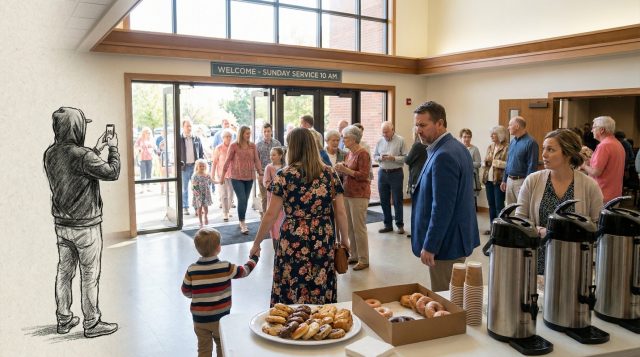
- Unfamiliar individuals filming or apparently testing entrances
- People, probably not familiar to anyone there, attending prior services without engaging; but attentive to the goings-on.
- Those same people may also exhibit a quiet but low-key curiosity, walking around.
- Paying attention to your cameras, testing angles before service begins.
- People walking around the campus with no real reason, or odd responses when approached, “I was lost”, or, “I was looking for…”. If it doesn’t fit and makes you curious, there’s potentially a good reason why.
- Unfamiliar people asking probing questions about times, video streaming, or other slightly unusual reasons.
- Vehicles that pull in, but no one gets out. They wait and maybe observe people coming and going, and later leave without coming in.
This is just a selection of what you might observe. There could be other signs, some more overt than covert. If there’s a flashing red light in the back of your mind telling you, ‘something’s-up’, listen to your instincts. Talk to others if you’re unsure. Only raise an alarm if there’s solid reason to do so. Keep your team and church on the same page, but relaxed and prepared. In all likelihood, none of this requires confrontation; and any of it could be perfectly innocent. You just need to be aware and have your eyes open.
Exterior Security: The Parking Lot Matters
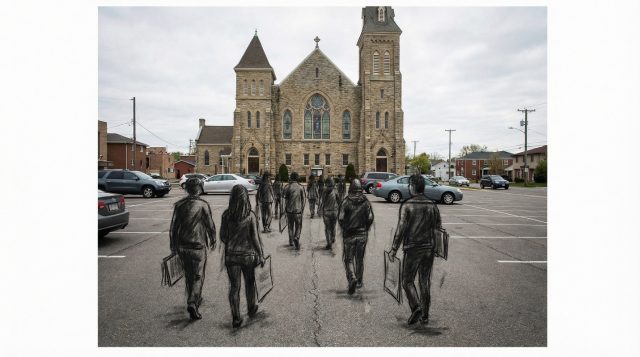
Most church security incidents begin outside, not inside. The vast majority of folks today drive to church. If, ten minutes into a service; six cars pull in at the same time; 15 people get out and approach together, it could be a family you recognize and you welcome them in; or there may be cause for concern. Protestors could well be carrying signs, placards, maybe a bullhorn; in other words, obvious items that don’t fit the regular Sunday service.
- Position trained greeters or security volunteers in parking areas and by entrances.
- Teach them to recognize coordinated arrivals:
- Groups arriving together
- Signs, banners, sound amplifying devices
- Professional camera gear, or many of them holding their phone in a ‘ready’ position.
- When lawful and appropriate, restrict sanctuary access if a group clearly intends disruption rather than worship.
Denying interior access may shift protest activity outside. That is not failure. That is containment, and some control. We make it a practice to keep doors open before the service, but lock some to restrict access so we can maintain control. This would make it easier to prevent a group from entering if we saw them coming.
Conclusion to Part One
The incidents described above make one thing clear: disruption inside a sanctuary is no longer unthinkable. Whether driven by political tension, activist strategy, or symbolic targeting, houses of worship may now be viewed by some as acceptable stages for confrontation. Preparation, therefore, is not paranoia; it is responsible stewardship. Churches that think through authority structures, exterior awareness, and early-warning indicators before an incident occurs will respond with clarity rather than confusion. In the second half of this discussion, we move from understanding the pattern to continued implementation of structured, practical responses that preserve safety, legality, and witness when disruption begins. We move into the sanctuary, and understand the best do’s and don’ts in a difficult moment; remembering that this is just a passing moment; one where we cannot be swept into the stream of protest from provocateurs of many forms. We will overcome.