
Preface
This article addresses one specific, narrow, and tragic circumstance imagined from an almost limitless array of possibilities: the moment when an active attacker has already begun committing violence inside a place of worship. It does not advocate vigilantism, preemptive force, suspicion-based action, or the abandonment of law enforcement, faith or prayer. It does not glorify violence, weapons, or confrontation. Its sole purpose is to confront the reality that when murder is already underway, seconds matter, police are minutes away, and choices are limited, but urgent. Everything that follows is written with one aim only: preserving life, minimizing harm, and preparing people; mentally, morally, and practically, for a situation none of us want, but some will face.
********************
Before we kick in to that moment when you know something bad is happening, let’s quickly review. I trust by now you see the importance of the basics. Being prepared. Being organized, not the least of which is introducing the thought of, ‘What if?’ to team members, and the staff and also the congregation as best you see fit. The basics, and yes, I will harp on this over and over again, are the key to whatever comes next.
So, we’ve done our best to prepare. We’ve organized to a greater or lesser extent, and have prepared ourselves for problems, large or small. It is time to think about what we’d do when ‘it’ happens.
That emergency alerts you in any number of ways. Someone comes in with great urgency and demands instant response. The power goes out. There are sounds; loud and disturbing that don’t’ fit: shouting, breaking glass, an alarm, a siren or possibly even gunshots. Maybe all of the above; simultaneously. Now everyone has to decide what to do. Leaders and those practiced in response should take charge, or at the very least show the way, or be prepared to be the first on the scene to deal with it and address whatever it as best they can to resolve, warn and protect others.
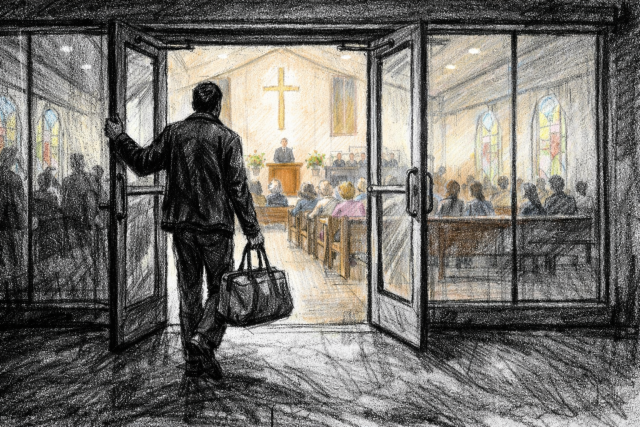
Given the multitude of possibilities, we can’t address everything, so we will take it from the point of view that an active shooter has come in to the church sanctuary during service and is beginning to shoot. Why, who and how many, we know not; only that there’s the sudden gut-wrenching sound of gunshots where none should ever be.
Run, hide, fight? Let’s look at this and see. Here’s a list of commonly heard and taught responses from across the English-speaking world. I’m sure there are other well publicized public safety phrases in other languages, but I’m going to concentrate on the one I’m familiar with, in English. If you’re reading a translated version of this, substitute as needed, for whatever you use, wherever you are.
| Run, Hide, Fight | The most widely promoted civilian response model in the U.S. |
| Avoid, Deny, Defend | A refinement often used by DHS and law-enforcement trainers. |
| See Something, Say Something | U.S. public awareness and reporting slogan. |
| See it. Say it. Sorted | UK public transport and counter-terrorism message. |
| Escape, Hide, Tell | Common UK variant aimed at simplicity and recall. |
| Run, Hide, Tell | Another UK-used adaptation, especially for schools. |
| Stay Safe | A broad, non-specific directive used during unfolding incidents. |
| Lock, Barricade, Communicate | Frequently taught in schools and workplaces. |
| Secure in Place / Shelter in Place | Used when evacuation is more dangerous. |
| Stop the Killing / Stop the Dying | Law-enforcement phrasing emphasizing immediate intervention and trauma care. |
| Escape and Evade | Military-derived phrasing sometimes used in higher-risk training. |
| Hide, Barricade, Counter | An older but still referenced training construct. |
There are other, lesser-known variants, but I’ll stop here. They all basically say the same thing: Run, hide, fight, with some saying to report; barricade. Report in our case will obviously be to call for law enforcement immediately, but if possible, it can also be to alert others present of the danger in their midst. For the sake of simplicity, I’m going to concentrate on the most popular by far, and most familiar; Run, Hide, Fight. This will probably be the default for most people.
I agree with this, for the most part, but I also see this as a very linear response. In other words, with a quick three-word phrase that is mentioned repeatedly, the first option is run, but if we can’t we should hide, but if not, as a last resort, fight. That’s the message we receive; but I will ask if we should look at this another way.
Circular over linear
Across the world, mass shooters act with a single, predetermined objective: to inflict maximum death and suffering. The scale of violence they intend defies words; the body count is never “enough.” Mercy has no place in their thinking. Screams, prayers, and pleas for help are answered not with hesitation or remorse, but with gunfire meant to silence and finish. They deliberately target those closest and most vulnerable, killing without restraint. This is disturbing to confront, and I do not state it lightly, but it is the stark reality we must face if violence erupts; and one we must prepare for beforehand. I stress this bluntly because when a mass shooter or terrorist begins their attack, they are driven by one goal alone: whatever they can do to bring death. We must answer with the direct opposite: whatever we can do to preserve life.
…every second counts
So, let’s return to the hypothetical mass shooter I mentioned previously, who has come in to the sanctuary and has fired off a shot. As we do this, let’s remember that from that second on, when the first shot rings out; everything that happens from that point on is bad. More on that later. We are past the point of maybes and what-ifs; it’s happening. Also, remember the reality that when you call 9-1-1 to summon the police, they are minutes away when, right now, every second counts. That is not a criticism of the police; far from it from someone who was a cop; but that’s simply realism. Between that first shot and their arrival, what is going to be done to stop the killing? We’ll return to that thought, but let’s get a better idea of this theoretical scenario.
For our hypothetical shooter we have a very basic diagram of him inside an imagined, generic sanctuary. The active shooter is represented by the stick figure inside the oval. In regards to the layout of the church, there are four emergency exits, labelled, two to each side, front and back. There are four doors in and out of the sanctuary; two double doors in the middle, and a single door either side, labelled Enter/Exit with the white double opposing arrows. Also, this diagram is not to scale, and is not based on any real or known sanctuary. It is merely a basic representation of a mid-size church. In this case, I would imagine a capacity of 250. Further, we’ll imagine there are 125 attending the service, plus the pastor and staff.
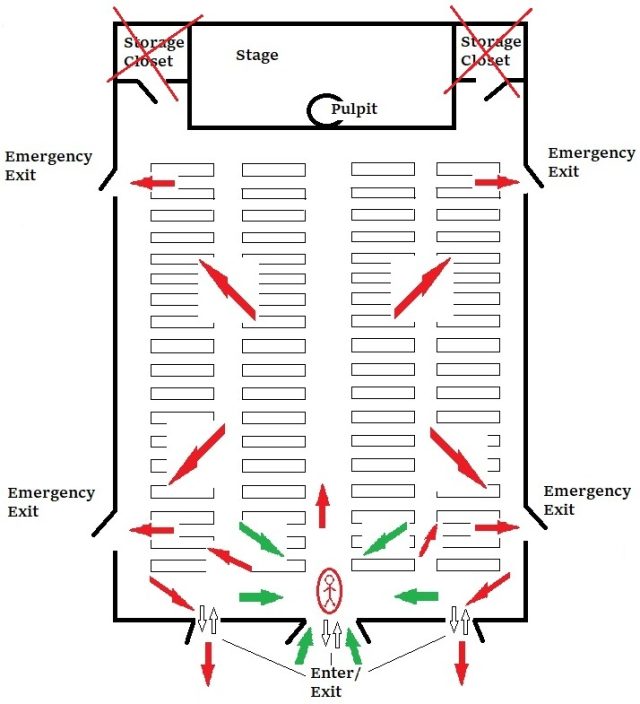
As you study this diagram, the first question could well be about what the arrows represent. They are there to depict what it would be in reality; chaotic movement. First, the red arrows represent what most should do if they can; and that is, get out. Get to the closest exit and create as much distance with as much cover between you and the shooter as possible. The red crosses over the storage closets indicate this is probably not a good place to hide or seek refuge.
The difference between cover and concealment
Cover is something that is solid and has a good chance of being able to stop a bullet. Firstly it provides a place to hide behind and secondly, it could protect you from a bullet fired at you. Standing behind a brick wall is good cover. Two is better. You cannot be seen, and the chances of many calibers of bullets getting through are minimal.
Concealment means something you can hide behind, and not be seen, but it won’t stop a bullet. You could stand behind a curtain and not be seen, but it will not stop any kind of bullet, and thus affords no protection beyond not being seen.
The green arrows represent what many will recoil in horror from when I define them. Those are the potential avenues of attack. Attack with what? By whom? By those immediately threatened and unable or unlikely to escape, by whatever means they can find in an instant. When? As soon as possible and continually until the threat is neutralized, with as much determination and speed as you can muster in order to eliminate the threat. When someone has come in and is beginning to shoot, from that second on it’s an extreme threat which dictates whatever response is necessary to stop it. As I mentioned previously, when it starts, everything from that point forward is bad. After reading this article, pause and reflect on what you would do.
If you need a deep dive into this theory, I strongly suggest reading the excellent book by Ed Monk, Lt Colonel US Army (Retired): ‘First 30 Seconds’. It goes into great detail and reviews actual cases of mass shooters; how some occurred and how some were stopped.
Some basic considerations about what happens in mass shootings before we delve into the, ‘attack the attacker’ approach.
- The shooter/s target those closest to them first. These are the easiest targets to hit.
- Without an armed presence to oppose the attacker, they have the firepower to run rampant and dictate what happens. They are in control.
- The typical police response is 3-7 minutes away. At a very slow, one shot every two seconds; in 3 minutes – probably the unlikely best case police response scenario – that’s 90 shots. 90 bullets. How many people can 90 bullets kill?
- If calling for help via the police is the only or primary defense, expect a large number of dead people with the number rising rapidly by the second as you wait minutes for the arrival of the police.
- The mass shooter’s intent is to kill as many as possible.
- Many mass shooters are not very good with their guns. Misfires are frequent, reloads can be slow. These are pauses where they are vulnerable to attack.
- Hoping for the worst not to happen is not a plan. Hope is not a strategy; it’s a fantasy.
- Mass shooters aim to attack vulnerabilities. Easy targets. They seek out the places where they can inflict the most deaths.
- Mass shooters are also known to study their target and plan the best way to do their worst, seeking the place where they will find the least resistance.
Those furthest away from the shooter, and/or close to an exit are in the best position which they should immediately take advantage of, so they can escape being in harm’s way. But for those closest to the shooter when he enters, they will have a harder time running away because they will likely be among the first targets, and they will have further to go. They are also in the best position to attack the shooter. Yes, attack the shooter.
Now let’s get to that circular over linear thought process. When someone throws a punch or a cup of water at you, your first reaction is to flinch; turn away; or back up. Natural, instinctive reactions. Just as when someone appears with a knife or gun and starts using it, running away is instinctive, and a good choice. It’s the first part of the, ‘Run/Hide/Fight’ saying. And thus, it’s perfectly natural, and a wise thing to do; if you can.
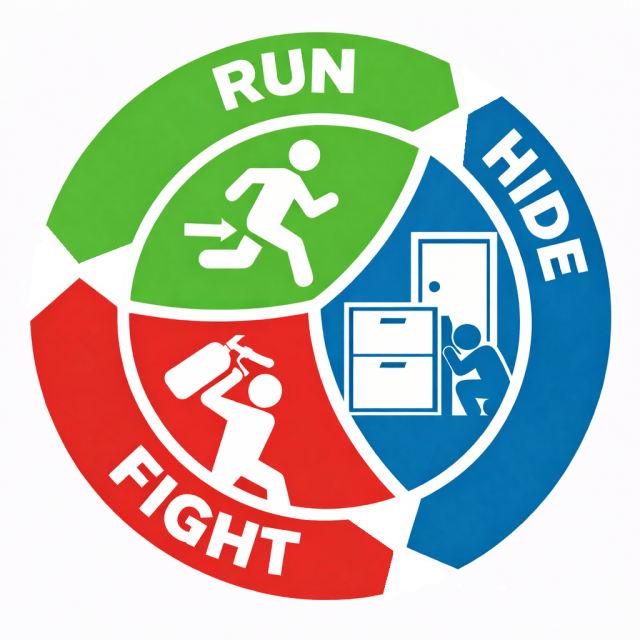
But for those close by, the best course of action may be to attack the shooter. For them, they may need to start with fight instead of run, and then fight some more, until the threat is neutralized or to stop the killing until further help arrives and then neutralize the threat. In other words; don’t fixate on only doing things in order; run/hide/fight. Understand it could also be fight/run/hide, or hide/run/fight, or any combination that works best, run/fight/run/hide. As was mentioned previously, extreme threats met by extreme measures.
What I’m getting at is the need to both preserve life, by running, AND by fighting to stop the threat. As long as the threat is active, the shots and deaths will follow. The best thing that can happen, in an array of choices of which everything is bad, is to stop the threat as soon as possible. As long as everyone runs away from them, they will not be stopped unless they decide to stop, or they run out of bullets or the ability to shoot. As I mentioned before, there are no good choices to make. Everything is bad. But if the threat isn’t stopped, the results get worse, as I said, by the second. If the threat is stopped, or slowed, it’s not as bad, or it’s finished. Sorry, there is no ‘easy button’ here. This is the simple, cold hard reality some will face in future.
There aren’t any official guides or recommended best courses of action when faced with a shooter with obvious murderous intent who’s within 10 – 15 feet of you. Maybe closer. I cannot tell you what’s okay to do, or what’s not; other than to say; stop the threat. How is up to you. Prepare yourself by calculating what you would do at the time, recognizing that you may not be in a position to run away. Maybe you’re in a classroom with but one door and a non-functioning window with the shooter in the hallway. Then you may need to hide or barricade the door. Maybe be prepared with a makeshift weapon if they force their way in. Maybe you throw something through the window and escape. The choices here are endless, but mental preparation, NOT FIXATION, is an important part you need to run through your mind as you try to not be completely blindsided if it happens. Think of your options in a circular way where you could be forced into any of the three; hide, run or fight; rather than strictly adhering to the linear, orderly tradition we have heard so many times. To illustrate my recommendations, here is a diagram to illustrate.
The Aftermath
When the threat is neutralized or no longer present, we must then turn our attention to attending to those needing medical attention; and if necessary, keeping the threat neutralized. At this moment those still present will realize they are first responders. They are the first line of help. If they were able to overcome the attacker; they will have realized that earlier. First responder is a name we accept for emergency services: Police, Fire and EMS. But in reality, it’s an unofficial designation that can apply to any of us. We should all do what we can for those around us; to preserve and protect life until someone better positioned or more qualified arrives to take over. If you accidentally cut yourself and obviously will need stitches, you don’t wait for someone to cover the wound; to protect it and apply pressure; you do it yourself. You are your own first responder as you then seek medical attention.
The same goes for an emergency you find yourself in the middle of. The first people to respond; the first people to act in the scenario I’ve laid out previously, could be the intended victims. They can also be the first responders.
| New Life Church, Colorado Springs, Colorado (USA) | Dec 9 2007 | Shooter Matthew Murray opened fire in the foyer; volunteer security guard Jeanne Assam took cover, waited for him to approach, identified herself as security and shot him multiple times, stopping the attack. |
| Deer Creek Middle School, Littleton, Colorado (USA) | Feb 23 2010 | As a man walked through the parking lot shooting students with a rifle, math teacher David Benke and another teacher tackled him and pinned him to the ground, preventing further violence. |
| Seattle Pacific University, Seattle, Washington (USA) | Jun 5 2014 | A gunman armed with a shotgun and knife shot students; student hall monitor Jon Meis sprayed pepper spray on him while he reloaded, then tackled him; other students seized his gun and pinned him until police arrived. |
| Thalys high‑speed train near Arras, France | Aug 21 2015 | A heavily armed gunman opened fire on the Amsterdam‑Paris train; U.S. servicemen Spencer Stone, Alek Skarlatos and Anthony Sadler and British passenger Chris Norman charged him, with Stone tackling the gunman, Skarlatos wrestled away his rifle and the group beat him unconscious and tied him up. |
| Waffle House, Antioch, Tennessee (USA) | Apr 22 2018 | A gunman killed four and wounded others; unarmed customer James Shaw Jr. rushed him when the shooter paused to look at his rifle, wrestled the rifle away and threw it over the counter, causing the gunman to flee. |
| Chabad of Poway synagogue, Poway, California (USA) | Apr 27 2019 | A shooter opened fire on worshippers; Army veteran Oscar Stewart ran toward the gunman yelling, causing him to drop his weapon and flee; off‑duty Border Patrol agent Jonathan Morales fired at the fleeing car; the attacker was later captured. |
| West Freeway Church of Christ, White Settlement, Texas (USA) | Dec 29 2019 | A gunman fired a shotgun during communion; volunteer security team leader Jack Wilson drew his handgun and shot the attacker with a single round, killing him and ending the attack within seconds.
|
| Club Q nightclub, Colorado Springs, Colorado (USA) | Nov 19 2022 | A gunman fired on patrons; Army veteran Richard Fierro grabbed the attacker’s body armor, dragged him down and, with patron Thomas James, beat and pinned him until police arrived; police praised their courageous actions for saving lives. |
| CrossPointe Community Church, Wayne, Michigan (USA) | Jun 22 2025 | An attacker wearing a tactical vest and armed with multiple weapons began firing outside the church; deacon Richard Pryor rammed him with his pickup truck while security team member Jay Trombley fatally shot the gunman, an intervention police said prevented a large‑scale mass shooting.
|
Legal, Emotional, and Spiritual Effect
Stopping an attacker does not end the ordeal. In many ways, in fact it probably begins a different and quieter battle; one that unfolds over weeks, months, and sometimes years; even lifetimes.
First, there are legal realities. Anyone who intervenes; whether armed or unarmed, successful or not, should expect scrutiny. Statements will be taken. Investigations will occur. Even when actions are ruled justified, the process itself can be stressful and disorienting. This is not a reason to hesitate when lives are at stake, but it is a reality that must be acknowledged and prepared for ahead of time.
Second, there is emotional and psychological trauma. Those who act, those who witness, and those who survive may experience shock, guilt, anger, grief, or profound exhaustion. Some will question their decisions. Others will replay moments endlessly. Churches must be prepared to support not only victims, but protectors as well, offering counseling, pastoral care, and patience rather than expecting immediate normalcy.
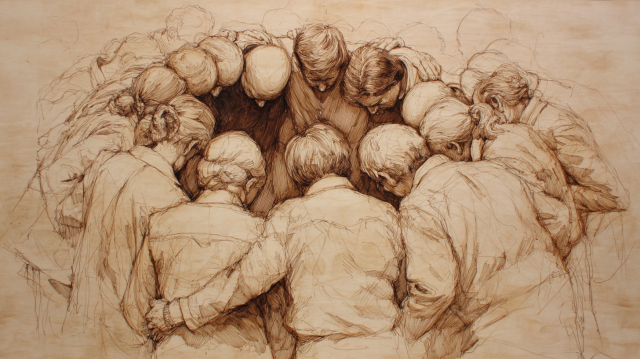
Finally, there is spiritual impact. Violence inside a place of worship wounds something deeper than the building and the bodies. Congregations may struggle with fear, doubt, or theological questions that have no simple answers. Leaders must create space for lament, prayer, honest conversation, and healing, without rushing to closure or platitudes. Preparing for this aftermath is not pessimism. It is pastoral responsibility. If we ask people to stand watch for the flock, we must also stand with them afterward.
Conclusion
Let me repeat what we know. The attacker has the advantage of the initiative. Action is quicker and comes before reaction. Attackers want to inflict the greatest amount of carnage; the most deaths they can. We must take steps to get our house in order. Start with and get the basics in place. Get away if you can. Stop the attack at the earliest possible opportunity.
Personally, I don’t want to see guns in church, but I utterly despise the thought of an attack in a house of worship. I realize we don’t live in a perfect world, so I believe the good guys should be equipped and ready to repel an attack; to effectively combat a deadly predator. If an opportunity presents to stop an attack; do it. Extraordinary times call for extraordinary measures. If we wait for help, waiting plays in to the hands of the one with the gun who just rack up a higher death count. As I said at the start, everything that happens after an attack begins is bad. Getting away if you can is good; but the fact that you may be trying to outrun a bullet is bad. Attacking a murderous gunman is certainly bad, but not trying to stop them is almost certainly worse. As Brian Cranston’s character in the film Argos said, “This is the best bad idea we have, sir… by far,”.
Preserve life, pass this along
It is with heavy heart that I write these words. They give me no satisfaction, and I find them thoroughly nauseating. My sincere hope is that they may one day prove their worth, although I pray there is no need, yet I know that day will come. Digest what has been said. Understand the honest intent. Preserve life. Pass this along. Pray we can preserve and protect as many lives as possible, and prevent evil from entering our house. Educate yourself, and understand the evil we face; that would devour us in any way it can. Then; open your eyes, your heart and your doors and welcome those who would seek the good word as we all stand watch; stand together.
What can I do now? Three Actions in the Next 30 Days
| 1. Form or review a safety team If you don’t have one, begin forming it. If you do, review roles, expectations, and training honestly. Know who is responsible for what, and who is willing to step forward if needed. |
| 2. Audit the basics; doors, exits, and medical readiness Walk the building. Open every exit. Identify bottlenecks. Check extinguishers, AEDs, and medical kits. Fix what is broken. These are simple steps that save lives. |
| 3. Begin calm, intentional education Not drills. Not fear. Just awareness. Teach situational awareness, exits, and basic response concepts over time. Confidence grows from understanding, not silence. Bring in outside expertise and experience. Reach out to other teams, other churches, and pool resources. |
Further reading: An excellent book, well worth the time for serious safety team members and all church hierarchy. Should be compulsory for schools as well, and any place where people gather in large numbers regularly that can and are targeted by terrorists and mass shooters. Thought provoking, honest and straight forward.