
Understanding the Levels of Safety and Security in Places of Worship
Applying the DHS/CISA Self-Assessment
The DHS/CISA Houses of Worship Security Self-Assessment Guide is structured around graduated maturity levels; from Very Low to Very High; across the domains of training, planning, reporting, perimeter security, and camera monitoring. When viewed through the Level 0 to Level 5 framework described in this article, the guide becomes a practical benchmark for any congregation to evaluate its readiness honestly.
If your leadership team were to complete the DHS self-assessment today, where would your place of worship fall? Are roles defined and documented? Are plans written, reviewed, and approved? Is training conducted annually, or better yet, quarterly? Are reporting mechanisms clear and practiced? Is there coordination with local first responders? Most congregations begin somewhere between Levels 1 and 3. The important issue is not comparison with other churches; it is clarity about your own.
So now, we are going to go through those same levels again, but instead of talking about them, we’re going to put ourself in a position to start acting on them; to get us from where we are and to where we need to be, taking real steps on the path towards a successful Safety Team.
Transition Guide: How to Move Between Levels
Knowing where you stand matters. Knowing how to move forward matters more. The following guide addresses each transition point: some of the primary obstacles you will face, the concrete steps to overcome them, what it will cost, and a realistic timeframe.
Level 0 → Level 1: From Silence to Awareness
The Obstacle: The primary obstacle here is theological or cultural discomfort. The belief that discussing security in a house of worship reflects a lack of faith. It does not. Locking the front door of your home at night is not faithlessness. Neither is watching the front door of your church. There is also the view that, “It’ll never happen here,” or, “It’s never happened here,” alone are sufficient reasons to stay in a state of delighted detachment.
Steps to Transition:
- Start the conversation. A pastor, elder, or board member raises the topic with leadership; not as a crisis response, but as stewardship. Examine past attacks and events in places of worship in the US and see what parallels are present between your church and those attacks.
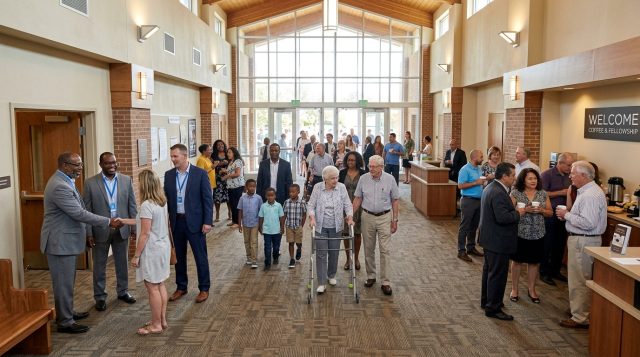
- Recognize that a safety ministry or team is not just about attacks or the worst of events, but following the Faith Guards teachings that it’s also about keeping an eye out for those everyday little things that will affect us all: trip hazards, helping the mobility impaired, fire hazards, smoothly functioning doors, cameras and burglar alarms.
- Identify one or two willing individuals. These are not yet a “team.” They are simply people who agree to pay attention and be a point of contact.
- Establish a basic reporting path. If someone sees something concerning, who do they tell? Even an informal answer to that question moves you out of Level 0.
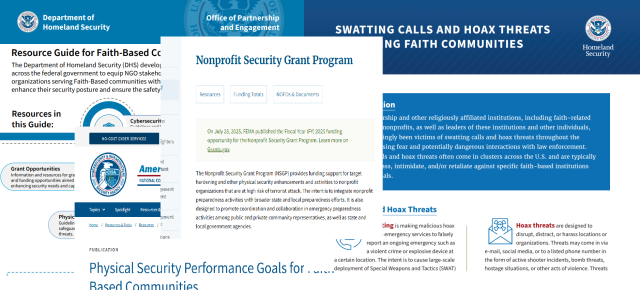
- Use a free resource as a conversation starter. The CISA “Six Steps to Enhance Security Against Targeted Violence” fact sheet or the DHS/CISA Self-Assessment Guide are both available at no cost and designed for people with no security background.
Cost: Zero dollars. This level costs nothing but a willingness to have an honest conversation.
Timeframe: Achievable in one to two leadership meetings.
Level 1 → Level 2: From Awareness to Team
The Obstacle: The common stall point is the volunteer gap. People are willing to be “aware” but reluctant to be named. There is also the assumption that a safety team requires law enforcement or military backgrounds. It does not. Any willing, trainable member can serve.
Steps to Transition:
- Formally identify and name your team. Announce it to leadership. Give it a name: Safety Team, Safety Ministry, Security Committee. The label matters less than the formality.
- Complete at least one structured training. FEMA IS-906 (“Workplace Security Awareness”) is free, online, and takes about an hour. It gives your team a shared baseline. (The FEMA IS-906 course is temporarily unavailable at the time of publishing this article, but we intend to have it, or a copy very close to it, available elsewhere on this website as soon as possible)
- Assign specific roles during services. Who watches the parking lot? Who monitors the lobby? Who are the people assigned and trusted to make an emergency call, and those there to greet and direct them when they arrive? Even a simple rotation schedule and recognized assignments and acceptance of those responsibilities counts.
- Install or activate a basic camera system at entry points. This does not require a professional installation. A consumer-grade system covering doors, and parking areas meets the basic threshold.
Cost: Minimal: likely under $500 for a basic camera setup if you do not already have one. Training is free.
Timeframe: Achievable in 30 to 60 days.
Define roles in writing
Level 2 → Level 3: From Team to Institution
The Obstacle: This is the documentation wall. Your people are willing and even trained, but nobody wants to write the policies. The shift from Level 2 to Level 3 is the shift from personality-driven safety to policy-driven safety. If your best team member leaves and the plan leaves with them, you are still at Level 2. Maybe the basic costs previously mentioned, under $500, are an obstacle. Maybe there’s no one person who wants to take the lead.
Steps to Transition:
- Write it down. A security plan does not need to be fifty pages. It needs to cover: who is on the team, what they do, how they communicate, and what happens in an emergency. Start with a two- to three-page document and build from there. Here, in the Faith Guards website we will soon have a resource page where some documents such as basic policies are free to download and adapt for your purposes. No need to start from scratch. Copy and paste and make it yours.
- Have leadership review and formally approve the plan. This gives it institutional weight. It is no longer “Joe’s idea”, it is the church’s policy.
- Define roles in writing. Who is the Director of Safety? Who sits on the Safety Committee? What are their responsibilities? Document these even if the team is only three people.
- Rather than one dominant leader; which isn’t necessarily objectionable; aim to have several people who are capable of leading and keeping it going. In the event of someone moving; someone becoming ill or for any other reason; this means that one sudden absence doesn’t cripple the mission. Continuity, and sharing the load.
- Ask your congregation to contribute to a new ministry; the Safety Team/Ministry. Seek assistance from other teams; other churches or your diocese, via your district superintendent, or bishop. Seek donations from businesses. The basic costs shouldn’t be too much, and shouldn’t present an obstacle with a little digging and effort.
- Establish a formal coordination relationship with local law enforcement. Introduce yourselves. Share your plan. Ask about their response protocols for your area. Many departments welcome this outreach.
- Begin a basic risk assessment. Walk your facility with fresh eyes. Where are the unlocked doors? Where are the blind spots? What happens during a Wednesday night children’s program versus a Sunday morning service? Write down what you find.
Cost: Still largely zero-dollar beyond printing and time. The CISA Self-Assessment Guide provides a free framework for the risk assessment.
Timeframe: Achievable in 60 to 90 days with a committed point person, or people.
Level 3 → Level 4: From Plan to Practice
The Obstacle: The practice gap. You have excellent plans that live in a binder on a shelf. The jump to Level 4 is the difference between having a plan and living by one. The most common excuse is “we don’t want to scare people.” A well-executed and communicated fire drill does not scare people. It prepares them. The same principle applies here. Then there’s the simple reality of practicing what you preach. The binder on the shelf isn’t open hearts and eyes and people in place. Once you put people in place, they will probably find the load is surprisingly light, making it easy to maintain.
Steps to Transition:
- Schedule and conduct your first tabletop exercise. This is not a full-scale drill; it’s a conversation around a table. “What would we do if someone walked in with a weapon during the 11:00 service?” CISA’s Community Tabletop Exercise Program (CTEP) provides free, pre-built templates designed for exactly this.
- Establish a quarterly training rhythm. Annual training is a Level 3 activity. Level 4 trains regularly; quarterly at minimum. Rotate topics: active threat response, medical emergencies, severe weather, fire, suspicious behavior.
- Implement after-action reviews. After every incident; and after every exercise; document what happened, what worked, what did not, and what you will change. This is where plans get better.
- Build a coverage schedule. Every service and event should have designated safety team members assigned; not just whoever happens to show up. This is a small but very important upgrade and establishes routine and regularity. It gives structure.
- Test your communication systems. If your team uses radios, phones, or a group text chain, test them under realistic conditions. A communication plan that has never been tested is a hope, not a plan.
Cost: Moderate; budget for radios if not already purchased ($200–$500 for a basic set), potential range fees if your team includes armed members, and any exercise-related supplies. Many costs remain in volunteer time rather than dollars.
Timeframe: This is not a one-time transition. It is a cultural shift that takes six to twelve months to become habitual.
Level 4 → Level 5: From Practiced to Professional
The Obstacle: The expertise and budget ceiling. Moving to Level 5 typically requires either hiring or contracting a credentialed security professional and aligning your plans with national preparedness frameworks. For smaller congregations, this may mean sharing a consultant with neighboring churches or partnering with a regional faith-based security organization. This may also be a step beyond where many small to medium churches need to be, more of a requirement for large churches and compulsory for the largest; what some call, ‘mega-churches.’
Steps to Transition:
- Engage a credentialed security professional. This may be a part-time hire, a contracted consultant, or a formal advisory relationship with someone holding relevant credentials (CPP, PSP, or equivalent law enforcement/military experience). Their role is to review, advise, and elevate; not to replace your volunteer team.
- Align your emergency plans with a recognized national framework. FEMA’s Comprehensive Preparedness Guide (CPG) 101 is the standard. Your plans should follow its structure: prevention, protection, mitigation, response, and recovery.
- Institute a formal annual review cycle. All security and emergency plans are reviewed, updated, and re-approved by leadership on a defined schedule, not just when someone remembers.
- Pursue grant funding. The FEMA Nonprofit Security Grant Program (NSGP) provides funding for physical security enhancements.
- Build succession into the structure. Document institutional knowledge. Cross-train team members. Ensure that the ministry survives any single departure; including the Director of Safety.
- Consider mentoring other congregations. A Level 5 ministry has the maturity to help neighboring houses of worship begin their own journey. This is ministry extending beyond your own walls. We must not stay only on our own island; but form bonds and open communication with others which will make us all stronger.
Cost: This is the first level where a real budget is typically required. Professional consulting fees, potential grant-writing costs, advanced training programs, and technology upgrades are common expenses. The NSGP can offset many of these.
Timeframe: Twelve to twenty-four months for full implementation, with ongoing refinement thereafter.
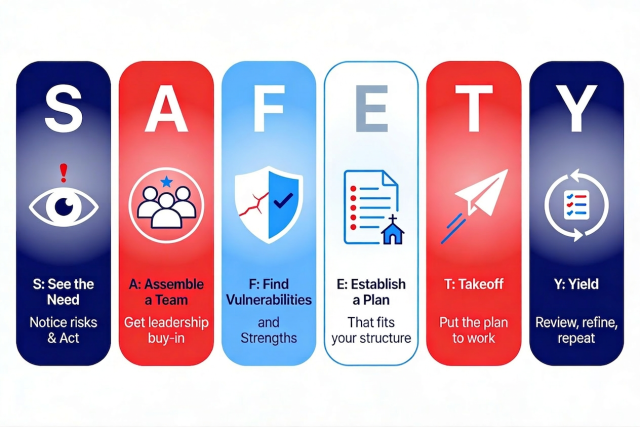
Conclusion: Structure Is Not Optional
The evidence is clear. A review of historical headlines over the past few decades shows that attacks on houses of worship are increasing in frequency, severity, and scope. The federal government has formally recognized places of worship as high-value targets for both domestic and foreign extremists. Radical groups have explicitly and openly declared their intent to strike at religious institutions, urging attacks. Lone-wolf attackers, motivated by their own twisted ideology, personal grievance, or hatred; and/or in response to those radical groups just mentioned, have demonstrated repeatedly that no faith community is immune.
In this environment, as I say all the time; hope is not a strategy; it’s a fantasy. Good intentions are not sufficient. A congregation that relies solely on the assumption that “it won’t happen here” is not exercising faith it is living in the fantasy world of hope.
At a minimum, every place of worship needs some formally recognized and organized team with written procedures. That does not mean every church must immediately achieve Level 5 professionalization. But it does mean that operating at Level 0 or Level 1 is no longer a responsible position for any congregation that takes seriously its duty to protect the people entrusted to its care.
A written safety plan, clearly defined roles, a recognized team, and basic coordination with local authorities; these are the baseline. They represent Level 2 moving toward Level 3 on the framework described here, and they are achievable for congregations of any size and budget. The DHS/CISA Self-Assessment Guide, the Nonprofit Security Grant Program, and resources from organizations like the FB-ISAO and FEMA provide free tools to help any congregation begin.
Everyone without any kind of team or effort yet realized starts from level 0. We’re all the same in that regard. Even the newly built, so-called ‘mega-church’, before it opens its’ doors, it has to start from scratch at 0. But once you understand, you can’t un-see what is before you. The key is honest assessment and steady progression. Safety is not about fear; nor is it about putting up walls and building a bunker; it is about stewardship. It is the recognition that the same shepherd who feeds the flock also guards the gate.
Peace in a house of worship should feel natural. Behind that peace, however, there should be thoughtful preparation. The question is not whether safety matters; it is what you and your congregation can do to prepare for it and provide it to the best of your ability.
A Final Word – IMPORTANT
No congregation should be disappointed about where it falls on this scale. Level 1 is infinitely better than Level 0. Level 2 is a real commitment. Level 3 is institutional maturity that most organizations never achieve. Every step forward is a step toward better stewardship of the people God has entrusted to your care.
The DHS/CISA Houses of Worship Security Self-Assessment Guide, the Nonprofit Security Grant Program, the FB-ISAO, FEMA training courses, and organizations like Faith Guards all exist to help your congregation move forward; at whatever pace is realistic for your size, budget, and culture.
Start where you are. Move when you can. The shepherd who feeds the flock also guards the gate.
What level is your place of worship operating at today—0 through 5?
Sources
- Family Research Council, “Hostility Against Churches in the United States: Analyzing Incidents from 2024,” August 2025. frc.org/issue analysis/hostility-against-churches-is-on-the-rise-in-the-united-states
- Faith-Based Information Sharing and Analysis Organization (FB-ISAO), “2024 Threat Data Review and Analysis,” May 2025. faithbased-isao.org
- Violence Prevention Project, omnilert.com; VOA Special Report, projects.voanews.com
- DHS, National Terrorism Advisory System Bulletin, May 24, 2023; DHS Homeland Threat Assessments 2024 and 2025
- Violence Prevention Project, House of Worship Homicides Database, 2000–2025. Referenced via omnilert.com
- VOA Special Report, “History of Mass Shooters: House of Worship Shootings.” projects.voanews.com
- A-Mark Foundation, “Violent Attacks on Houses of Worship.” amarkfoundation.org
- S. Department of Homeland Security, National Terrorism Advisory System Bulletin, May 24, 2023. dhs.gov
- S. Department of Homeland Security, 2024 and 2025 Homeland Threat Assessments. dhs.gov
- Federal Bureau of Investigation, “Violent Extremism and Terrorism: Examining the Threat to Houses of Worship and Public Spaces,” Congressional Testimony, March 2022. fbi.gov
- Joint Counterterrorism Assessment Team (JCAT/NCTC/DHS/FBI), “Threats Against Houses of Worship Highlight the Importance of Religious Community Outreach.” dni.gov
- DHS/CISA, Houses of Worship Security Self-Assessment Guide. cisa.gov
- DHS/CISA, Physical Security Performance Goals for Faith-Based Organizations, December 2023. dhs.gov
- DHS Nonprofit Security Grant Program (NSGP), FY2024. dhs.gov