
You’ve probably heard that before, only it’s usually the 800 pound gorilla. Gorillas certainly don’t get to 8,000 pounds. I don’t think they get to 800 either, but the idea of ten-folding the original already inflated concept was to make a point. That point is the likelihood of terror attacks here in the US, and the western world, like Europe. I can’t state it strongly enough, that the risk we face in future could be approaching extreme. Maybe, similar to my exaggerated gorilla, as much as ten-fold what we’ve seen before, referring to 9-11, which is what it’s believed they’re aiming for. Casualties in the tens of thousands. What this means is, we better have a mindset and state of preparation to match.
Up until September the 10th, 2001 I fully admit I really hadn’t paid too much attention to Al-Qaeda. On my personal radar screen they were way off to the side somewhere. Background noise in the news, little more. But all of us remember exactly what we were doing, and where we were that next day as we watched, aghast, as the towers fell. Indeed, from that day to this, a great many more of us are now acutely aware of the threats posed and additional major attacks as they happen practically anywhere in this worldwide phenomenon.
“Game, set and match…”
But to the more casual observer, someone not really in tune to the pulse of a world in great flux, the more observant of you may be surprised of what many perceive today. Many think we gained the upper hand after 9-11; that we fought them, and basically won. After all, we invaded Afghanistan and took over their adopted home, destroyed their bases and infrastructure, killed Bin Laden sometime later, and brought their leaders to justice. Game, set and match… If only it was that simple.
Our western idea of traditional war and conquest, as we read in our history books, tells us of wars, where, generally speaking, one side wins. That side dominates; hostilities cease. Maps and names may change, but after that things return to a new normal, and peace returns. But these are largely political disputes, territorial squabbles, or contests for resources.
Examples of Traditional Wars and Their Drivers
- American Revolutionary War — independence; self-governance
- World War I — empire rivalry; alliances; nationalism
- World War II — fascist expansion; global domination; survival
- Korean War — ideology; communism vs. democracy
- Vietnam War — containment; proxy conflict; ideology
- Gulf War (1991) — oil security; territorial integrity
- Iraq War (2003) — regime change; WMD fears; stability
- Falklands War — sovereignty; national pride
- Balkan Wars (1990s) — ethnic conflict; territorial breakup
- Ukraine (2022+) – Geopolitics, nationalism, resources, proxy war
Each of these wars, save the ongoing war in Ukraine at the time of this writing, for all their differences, eventually ended with treaties, borders re-drawn, and a new balance of power established. Even bitter conflicts had conclusions that could be mapped, signed, and taught in history books.

A Different Kind of War
But not all wars follow this pattern. Some aren’t about land or resources but about ideology; a vision of how the world must be shaped according to their very particular beliefs. These wars are not fought to achieve temporary political gains, not for freedom, but to enforce a way of life, and they are waged not for years, but across many generations. The groups who embrace this model do not expect to “win” in a single battle or even a single century. They wage their war by any means available; through terror, through exploitation of open societies, and even through demographics; the belief that the wombs of their women will carry their cause forward through a superior increase in their numbers until eventual dominance. More simply put, they have more babies, get more votes or power through greater numbers; they win.
“Our ideologies; our outlooks on life couldn’t be more different.”
This approach makes them patient; relentless; and difficult for the West to comprehend. Our systems are built for short campaigns, elections, and treaties. We may start a war, but then aim for peace and preservation of life. They aim for domination and are willing to use and take life. We want to get it over with, to cease and desist costly conflict as quickly as possible and move on. Their approach is built for endurance, sacrifice, and the long game of history. We generally ask for volunteers and promote personal dedication and growth along with national pride and service. They often forcibly conscript, subjugate, and also recruit the willing, glorifying death and are prepared to give their lives, believing that their cause is larger than themselves and must be carried forward until the day they declare victory, no matter the cost. Our ideologies; our outlooks on life couldn’t be more different.
Those who wage such long term, ideological war at all costs believe they cannot lose, because every act of terror, every life taken, every disruption, is a victory in itself. A, ‘glorious’, loss of life that will be richly rewarded in the hereafter. They don’t seek merely to conquer land; they aim to reshape thought, sow division, and slowly erode the freedoms that make open societies possible. Their battleground is everywhere; in cities, schools, marketplaces, buses, social media, the Internet, the streets, homes, the minds of our youth, the media, subways, and all sanctuaries, but most of all; hearts and minds. Anywhere and everywhere.
The proof is written in blood across continents, in attacks so shocking they seared themselves into the world’s collective memory. From the Middle East to Europe, from Africa to the Americas, these atrocities have followed the same grim pattern: sudden, merciless violence designed to terrify, destabilize, and remind us that their war is never finished. The following acts, occurring after 9-11, are widely considered as some of the worst over the past 25 years, also recognizing this is but a small number of the overall attacks and acts of terror worldwide.
Mar 22, 2024 Moscow, Russia: ISIS-K attacked a concert venue with gunfire and arson, killing 144; the group remains active and expanding from Central Asia and Afghanistan.
Oct 7, 2023 Israel: Hamas carried out mass assaults, shootings, hostage-taking, and rocket attacks, killing 1,194; Hamas remains active but heavily degraded.
Apr 21, 2019 Sri Lanka: ISIS-linked militants conducted coordinated Easter suicide bombings at churches and hotels, killing 259; the network is largely dismantled.
Nov 24, 2017 Bir al-Abed, Egypt: ISIS bombed and shot worshipers at a Sufi mosque, killing 309; ISIS remains active but weaker.
Oct 14, 2017 Mogadishu, Somalia: Al-Shabaab used a truck bomb at a busy intersection, killing 587; the group remains highly active.
Jul 3, 2016 Baghdad, Iraq: ISIS detonated a truck bomb in a crowded market, killing 324; ISIS is weaker but still globally active.
Nov 13, 2015Paris, France: ISIS carried out coordinated shootings and suicide bombings, killing 130; the group is significantly weakened.
Oct 31, 2015 Sinai, Egypt: ISIS downed a Russian airliner with an onboard bomb, killing 224; ISIS remains active but reduced.
Nov 26–29, 2008 Mumbai, India: Lashkar-e-Taiba conducted multi-day assaults on hotels and transit hubs, killing 175; the group remains active under pressure.
Aug 14, 2007 Iraq: Al-Qaeda in Iraq used coordinated truck bombs against Yazidi communities, killing 520; Al-Qaeda is weaker and fragmented.
Jul 7, 2005 London, England: Al-Qaeda-aligned extremists carried out coordinated transit bombings, killing 52; Al-Qaeda persists but weakened.
Sep 1–3, 2004 Beslan, Russia: Chechen Islamist militants seized a school in a hostage siege, killing 372; the group is defunct.
Oct 12, 2002 Bali, Indonesia: Al-Qaeda-linked Jemaah Islamiyah bombed nightclubs, killing 202; the group remains active but weakened.
And so we must name them plainly: al-Qaeda, ISIS, Boko Haram, al-Shabab, Hezbollah, and the many smaller factions that pledge allegiance to their cause. These groups differ in size, scope, and geography, but their unifying thread is the same: a ruthless pursuit of power through terror, intimidation, and death. Naming them strips away vagueness and forces us to confront the reality; this is not some faceless, formless danger, but identifiable movements with leaders, strategies, and networks bent on destruction.
All of these attacks share commonalities. Firstly, al-Qaeda, ISIS, Boko Haram, and al-Shabab represent radical fundamentalist Sunni Islamist extremism, while Hezbollah represents a radical fundamentalist Shia Islamist extremism; together, they form the most notorious examples of violent religious militancy in the modern era. Radical fundamentalist Islamist Extremism.
Secondly, they involved explosives, such as truck bombs, suicide bombings, or IEDs, often combined with shootings or hostage-taking for prolonged and maximum impact, meaning deaths, and shock value. Some; Mumbai, Paris and Israel, were coordinated, multi-phase operations. This is evidence of a shift toward hybrid attacks designed to overwhelm responders and maximize chaos and the death count.
Third, target selection is on soft targets, often in public places; locations where people have gathered such as concerts, markets, hotels, schools and places of worship. This affords them the highest possible casualty count. This perfectly aligns with the definition of terrorism as violence against civilians for ideological goals, a pattern that has intensified worldwide since 9/11.
Forth, a high casualty death toll. The lowest number deaths on the list is 52. They want a shocking spectacle, and the highest body-count possible.
What else can we take away from this?
- These attacks can happen anywhere. The list shown includes multiple areas; Middle East (Iraq, Egypt), South Asia (India, Sri Lanka), Africa (Somalia), Europe (France, England, Russia), and beyond (Israel, Indonesia). This is a global phenomenon.
- They are persistent, and most are still active today.
- Today these groups are also decentralized, making them harder to track and target, and the threat of global terrorism, with practically unanimous agreement, is on the rise.
It’s at this point you may be forgiven if you decide to take solace in seeing such evil in locations thousands of miles away, on completely different continents, assuming you’re reading this in the United States, and ignoring or dismissing 9-11 as one-and-done. That’s one of America’s great strengths; it’s relative isolation from its’ enemies, surrounded by oceans and Gulfs, and bordered by friendly countries. And, with this relative isolation we have been able to control our borders accordingly. Insert dramatic pause, for effect.
So let’s discuss the hot topic of control of our borders. Politics aside, an open border to what many would call the, ‘Land of Plenty’, is attractive to those coming from comparatively poorer parts of the world. Asylum is the claim most make as they cross the border, which is largely regarded as the excuse used to circumvent the system and gain access to greater opportunities than where they came from. Most recognize, whether they would publicly admit it or not, that only a minority of those asylum claims are thought to be genuine.
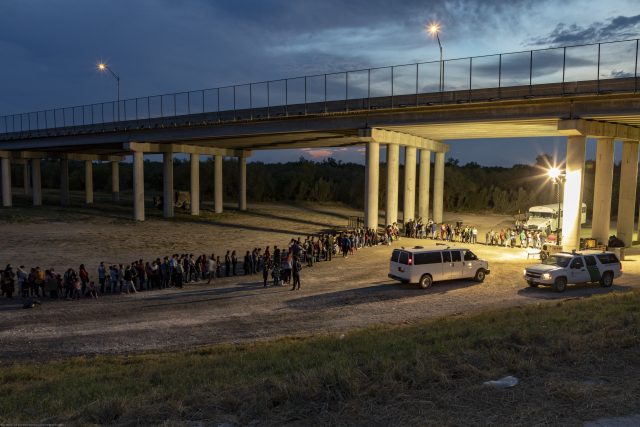
Photo by Mani Albrecht U.S. Customs and Border Protection Office of Public Affairs
Visual Communications Division
Even though you may have strong political leanings with illegal immigration, the fact is, for our enemies, those who want to do us harm, everyone must recognize that open borders also represent easy access. But in truth, as easy as open access made it, there may not be a need to have someone come in illegally. For 9-11, there were 19 hijackers, 20 if you count Zacarias Moussaoui who was arrested before and did not take part. All of them entered the United States legally, on temporary tourist, business or student visas. 15 of them came in from an ally of ours, Saudi Arabia.
Today, there are many places a potential terrorist could obtain a passport and apply for a temporary visa to enter the US from. Places like Afghanistan and Libya, amongst others, are rife with corruption where passports are available for purchase. But an open border negates the need for visas, meaning access whether legal or otherwise, provides sufficient opportunity for those with an agenda.
And then there are the others. While we started this entry by recognizing the potential of an 8,000 pound gorilla in the form or radical Islamic terrorism, we must also recognize the many threats that have festered from within. As if foreign based fundamental Islamic extremism isn’t enough, we also face domestic ideological extremists; primarily those driven by raw hatred of one faith or another, or by the poison of racial resentment. Add to that the unstable and unwell; the mentally broken who see infamy as positive purpose, and you realize the threat landscape is wide. You dare not focus on but the one or two most prevalent, or that which is in the news today; for tomorrow it can all change. Evil wears many faces and takes many forms. Then layered atop that depravity comes something disturbingly familiar: personal grudges and vendettas; and family disputes. Time and again, mass shootings in the U.S. have been traced not only to ideology, but to anger. Festering, personal resentment in addition to ideological hatred, tragically unleashed and committed by those from within.
Selected Ideologically Motivated Attacks (Recent History)
United States
- 2025, Michigan: A U.S.-born Marine veteran attacked an LDS chapel using a vehicle, gunfire, and arson, killing four; the FBI identified targeted anti-Mormon violence.
- 2025, Louisiana: A Texas-born U.S. citizen carried out a vehicle ramming and shooting on Bourbon Street, killing fourteen; ISIS-inspired.
- 2022, New York: A New York-born attacker conducted a racially motivated supermarket shooting, killing ten; driven by far-right extremism.
- 2019, Texas: A Texas-born gunman attacked a Walmart targeting Latinos, killing twenty-three; motivated by white supremacist ideology.
- 2018, Pennsylvania: A Pennsylvania-born attacker murdered worshipers at a synagogue, killing eleven; driven by far-right antisemitic extremism.
- 2016, Florida: A U.S.-born attacker killed forty-nine in a nightclub shooting; ISIS-inspired.
- 2015, California: A U.S.-born man and foreign-born spouse attacked a county gathering, killing fourteen; ISIS-inspired.
- 2009, Texas: A U.S.-born Army officer killed thirteen at Fort Hood; Al-Qaeda-inspired.
United Kingdom
- 2019, London: A UK-born attacker stabbed civilians near London Bridge, killing two; ISIS-inspired.
- 2017, London: An ISIS-inspired cell used vehicle ramming and stabbings at London Bridge and Borough Market, killing eight.
- 2017, Manchester: A UK-born suicide bomber attacked a concert venue, killing twenty-two; ISIS-inspired.
- 2017, London: A UK-born Islamist convert rammed pedestrians and stabbed a police officer near Parliament, killing five; ISIS-inspired.
- 2005, London: British citizens carried out coordinated transit bombings, killing fifty-two; Al-Qaeda-inspired.
Australia
- 2025, Sydney: A father; Pakistani immigrant, and his son, born in Australia, carried out a mass shooting that left 15 dead and dozens injured. ISIS-inspired.
- 2018, Melbourne: An attacker raised in Australia carried out a vehicle and stabbing attack on Bourke Street, killing one; ISIS-inspired.
- 2017, New South Wales: Australian-born teenagers conducted stabbing attacks, killing one; linked to ISIS sympathies.
- 2016, New South Wales: An Australian-born attacker stabbed a victim in a public park; ISIS-inspired.
- 2014, Melbourne: An attacker raised in Australia stabbed police outside a station; ISIS-inspired.
Summary
- United States: Seven of eight attacks were fully homegrown (Grand Blanc – Michigan, New Orleans, Orlando, El Paso, Fort Hood, Pittsburgh, Buffalo); one was partially homegrown (San Bernardino, with Farook as a U.S. citizen and Malik as a foreign national).
- United Kingdom: Four of five attacks were fully homegrown (London 7/7, Manchester, Westminster, London 2019); one was partially homegrown (London Bridge 2017).
- Australia: Three of four attacks were fully homegrown (Queanbeyan, Minto, Melbourne 2014); one was partially homegrown (Melbourne 2018).
These cases demonstrate that modern violent threats are not imported anomalies, but often arise from those born or raised within the societies they attack. Ideology, whether religious extremism, racial hatred, or targeted hostility toward faith communities, consistently shapes target selection, tactics, and warning behaviors. Awareness of these patterns is not political; it is protective.
On June 17, one hot summer night back in 2015, in one of the south’s oldest black churches, the historic Emanuel African Methodist Episcopal Church in Charleston, shots rang out. A white killer sat through an hour-long bible study, and then opened fire on the others present, all black, with the intent of starting a race war. When the shooting was over, nine laid dead. Simple racial hatred. Another tragedy no one saw coming, and a terrible example of the horror that homegrown hatred can inflict.

“..most attackers are not outsiders..”
Across these incidents, several consistent patterns emerge that are directly relevant to houses of worship. Attack methods frequently combine simple, readily available tools; vehicles, knives, fire and firearms, often used in sequence to maximize confusion and casualties. Targets are chosen for symbolic value and predictability: worship services, religious gatherings, public celebrations, and locations with open access and limited or usually, no screening. Escalation commonly follows a recognizable arc, beginning with grievance formation and ideological fixation, progressing through online reinforcement in the plentiful echo chambers available today, associated behavioral leakage, and coming to a head in rapid, opportunistic attacks rather than complex plots. For church safety teams, this underscores the importance of early behavioral awareness, exterior vigilance, vehicle threat considerations, and calm, coordinated response, recognizing that most attackers are not outsiders but individuals who understand the environment they intend to attack/exploit.
Conclusion
The threat of ideological terrorism, exemplified by groups like al-Qaeda, ISIS, and Hezbollah, transcends borders and defies traditional notions of warfare. Plots are often hatched remotely anywhere across the globe, exploiting digital networks and free travel to radicalize, coordinate and conduct attacks. Additionally, homegrown extremism emerges from within our own communities, fueled by both local and personal grievances or online propaganda. Both international and domestic threats demand a vigilant and adaptive response from open societies. Our openness, a strength and benefit from centuries of sacrifice, crafted at great cost by those who came before us, some of whom gave all to create what we enjoy today; is precisely what our enemies would use against us.
If we are committed to doing all we can to eradicate evil, we must strengthen intelligence, secure borders, increase awareness and understanding, and foster societal resilience; all critical to counter this multi-headed menace. While our Western values of peace and freedom remain our greatest strength, we must confront this 8,000-pound gorilla with unwavering resolve, balancing security with the preservation of our freedoms and core principles. We have to ensure that our way of life endures against those who seek to dismantle it through fear, through great violence, and through as many deaths as they can manage. At the same time, we cannot turn our churches into forts, the church doors must remain open, as should our hearts no matter the threats we face. In Part 2, we’ll shift from history to current intelligence, what’s active now, what’s growing, and what many analysts believe are the most likely methods and targets for the next major attacks. If Part 1 is the warning bell, Part 2 is the map.
Further Reading
“Islamic Fundamentalism: An Introduction” – Sociological overview from Easy Sociology (2024). https://easysociology.com/sociology-of-religion/islamic-fundamentalism-an-introduction/
“Islam and the West: Navigating the Cultural and Theological Divide” – Merion West (August 4, 2025 republication/update). Discusses deep cultural and theological divisions, including fundamentalist interpretations contrasting with Western principles. https://www.merionwest.com/islam-and-the-west-navigating-the-cultural-and-theological-divide/
DHS’ 2025 Homeland Threat Assessment Indicates the Threat of Domestic and Foreign Terrorism in the Homeland Remains High Published by the Department of Homeland Security (October 2024, with 2025 relevance). The official DHS report assesses that lone offenders and small groups pose the greatest terrorism threat to the US, driven by domestic and international factors including the 2024 election and global conflicts. https://www.dhs.gov/archive/news/2024/10/02/dhs-2025-homeland-threat-assessment-indicates-threat-domestic-and-foreign-terrorism/